










Ports de balears

ir a administración electrónica
Ir a Canal Ético

The port of La Savina, front page of the APB calendar for 2026

Autoridad Portuaria de Baleares (Port Authority of the Balearic Islands) dedicates its Christmas card and the 2026 calendar to the port of La Savina with illustrations by Vero Sobrinho and thus ends the five-year cycle of paying tribute to each of the five public ports that it manages. In 2022 the calendar was dedicated to the port of Palma with illustrations by Georgina Gamundí; in 2023 to Eivissa, with Diana Bustamante as guest illustrator; in 2024 it was the turn of the port of Maó with Iván Triay; and in 2025 it focused on the port of Alcúdia, with illustrations by Margalida Vinyes. Each of the artists has a direct relationship with the island harbour they draw.


Half Andalusian, half Brazilian, but raised in Formentera, Vero Sobrinho has dedicated the cover of the new year 2026 to the port of La Savina. A drawing instructor, after receiving her academic training in graphic arts, she is one of the promising young Pitiusan artists who is making her way professionally in the world of illustration.


— Vero, tell us what this commission has meant to you.


— It has been a very fun experience and, at the same time, very useful to grow as an artist. Being a novice myself, it has been the perfect opportunity to evolve and learn. I was also ecstatic to be able to illustrate the beautiful landscapes of the Balearic Islands. It's something I've always admired!


— The 2026 calendar is dedicated to the port of La Savina. How did you find inspiration to capture the essence of these spaces so essential to the inhabitants of Formentera?


— I took many walks around the port of La Savina and I realised that the part that stirs up most nostalgia and interest in me is the idea that all the local inhabitants have inevitably passed through it several times and, despite the years gone by, it never loses its charm. I wanted to reflect this in the drawing of the port, with the illustration of the tall palm trees, the countless fishing boats, the long walkway that in summer is filled with little craft shops... It is a pleasant and, I think, iconic image of the port. For the cover I chose this specific angle to highlight the view that anyone might have when approaching the pier: the stairs, the harbour station in the background, a ferry sailing off, a beautiful seascape accompanied by a cormorant and the classic scene of a podenco hound waiting for its master. Small details that the people of Formentera recognise instantly!


— Was there a particular port or scene that you found most special or moving to illustrate?


— If we talk about the most complicated drawing, it is undoubtedly the one in Maó, Menorca. I wanted to include a lot of details, following the same style that I have used in all the illustrations, but it ended up taking me more time than I expected. In addition, the location of the sailboat was also a bit difficult to fit in, but after several tries the final version came out.


— Your work has a very distinctive style. How would you describe your visual language? Do you think you take any inspiration from other artists from Formentera?


— I would say that it is a style with a pictorial touch, trying to imitate the effect achieved with acrylic paints or gouache, although it has been done digitally. I adapted this style with a great deal of time and patience, in a totally autonomous and personal manner. As for my interest in drawing landscapes—something that has never been my strong suit—it has been totally inspired by Feliu Renom, a landscape artist that you probably already know, an icon of Mallorca. His illustrations of natural and urban scenes of the Balearic Islands, drawn with detail and precision and adorned with watercolour spots, were key for me a few years ago. Getting to know his work and, above all, having had the opportunity to meet him in person, visit his studio and see his modus operandi was a real source of inspiration. Thanks to this, I have tried to dedicate more time to life drawing, and this has made me feel much more confident and given me a solid foundation in which to take on this project.


— What was the preliminary research like? Did you visit the ports in person or did you rely on photographs and documentation?


— The ports that were close to me (La Savina and Eivissa) I visited in person to capture their essence. In the case of the more distant ones, I searched for images in the gallery offered by the Ports de Balears website. I also found some photographs of friends living in Menorca and Mallorca very useful.


— Animals are a very common resource in your illustrations. Explain how you decide on their presence.


— As for the presence of animals, it is simply a matter of logic and personal taste. Some images contain seabirds, which are almost obligatory in coastal areas. And there is a goat that appears by a beautiful coincidence: a shepherd who lives near the Botafoc lighthouse used to let them graze in an area nearby and it was an inspiration.


— Before this work, were you familiar with the public ports of the Balearic Islands and the lighthouses managed by Autoridad Portuaria de Baleares?


— There are some that I did not expect to be managed by Ports de Balears. It was really interesting to find out!


— What do you hope the public will perceive when they see the calendar? What message or emotion do you want to convey with your illustrations?


— I hope they can perceive the admiration I feel for the clarity, the brightness and the serenity of these scenes. I would like to convey to them the same feeling I experienced while I was drawing them: affection. The sincere affection I have for our beautiful islands and the enormous gratitude I feel for having had the good fortune to be able to depict them.


The ports of Palma and Valencia and the shipping company Baleària promote a green maritime corridor with zero emissions as of 2030

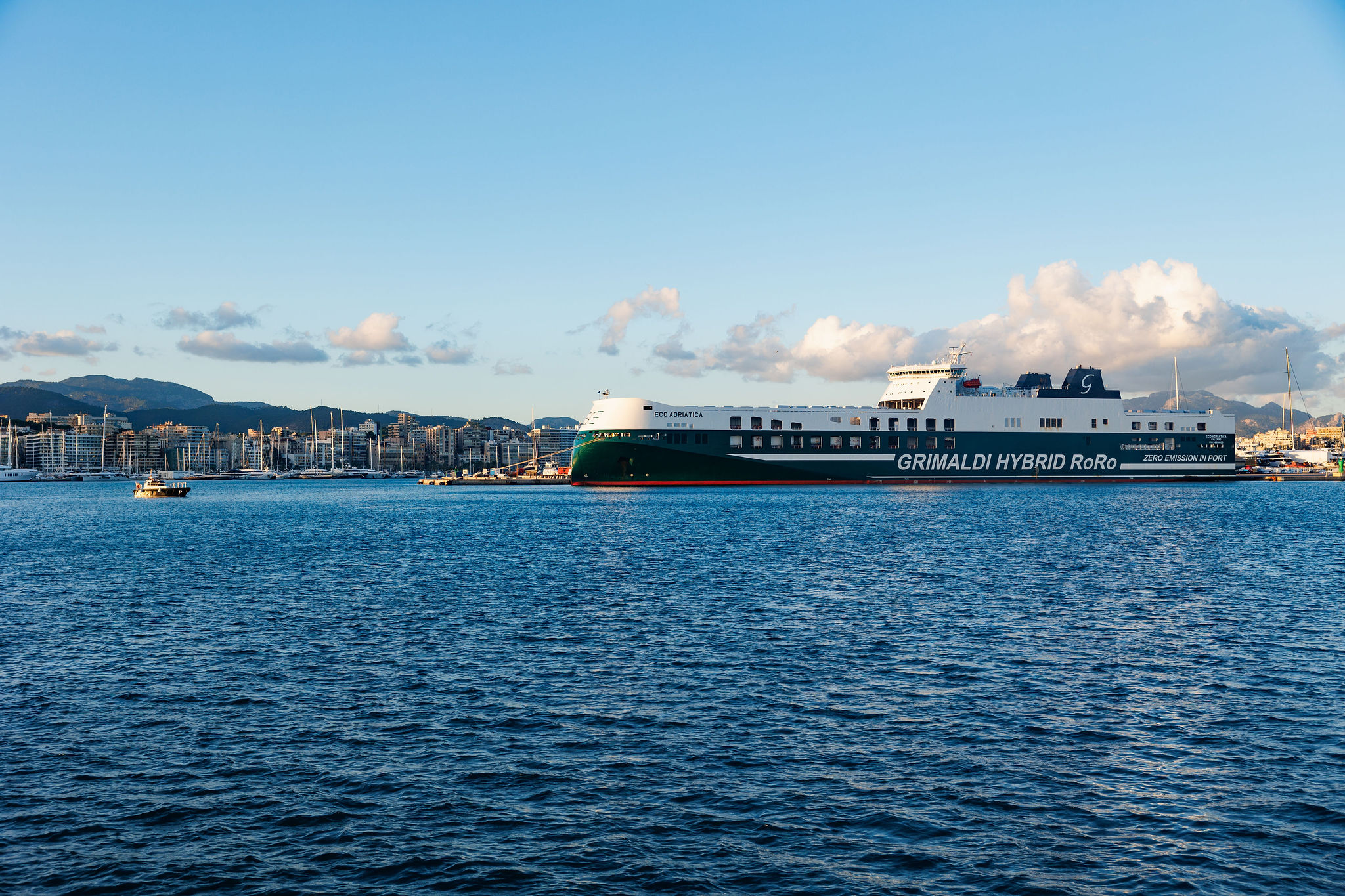
The ports of Palma and Valencia and the shipping company Baleària have today signed a collaboration agreement to develop the first green maritime corridor in Spain. The initiative, which promotes the decarbonisation of the maritime-port sector, sets the year 2030 as the horizon for operating with zero emissions on this route, through the use of biofuels in the two Baleària ships that provide passenger and freight transport services on this line. The Chairman of Baleària, Adolfo Utor; the President of the Port Authority of Valencia, Mar Chao, and the President of the Port Authority of the Balearic Islands, Javier Sanz, signed the agreement today at the presentation of the project in Valencia, which was attended by Joan Groizard, Secretary of State for Energy of the Ministry for Ecological Transition and the Demographic Challenge, and Benito Núñez, Secretary General for Air and Maritime Transport, Ministry of Transport and Sustainable Mobility.


Baleària aims to decarbonise the route between Valencia and Palma by 2030. To this end, it will assign two of its ships to this line, equipped with dual engines that will consume only biogas in 2030, achieving zero emissions. In addition, Baleària will incorporate batteries on board to provide renewable electricity for auxiliary uses during navigation and will install OPS connection systems on board.


The chairman of Baleària, Adolfo Utor, stressed that this is a pioneering project for the decarbonisation of the Spanish maritime sector: “It is a sustainable competitive bet, which will be two decades ahead of the goal of zero emissions by 2050. The Valencia-Palma route will be the first green corridor between two Spanish ports. This public-private agreement will mean a significant advance in the mobility of passengers and essential goods between the mainland and the Balearic Islands”.


For their part, the port authorities of Valencia and the Balearic Islands, as part of their decarbonisation plans, will accelerate the construction of infrastructures for charging batteries in port, and will explore the availability and development of low-carbon fuel supplies.


The president of the Balearic Islands Port Authority, Javier Sanz, stressed that “protecting our sea and our cities is compatible with port development; in fact, it is a condition for sustainable development. Balearic ports have the responsibility and the opportunity to lead the transition to cleaner and quieter maritime activities”.


On the other hand, the president of Valenciaport, Mar Chao, pointed out that “this green corridor reinforces the leadership of the company that promotes it, and contributes to strengthening the strength of the Valenciaport port community in the process of decarbonisation that unites us”. He also explained that the project is in line with the roadmap set by the Port Authority through the Net Zero Emissions Plan: “A sum of public and private investments to develop actions for the benefit of other less polluting and more efficient energy sources. A clear demonstration that together we can go further”.


Baleària's green maritime corridor between the ports of Valencia and Palma will play a vital role in the decarbonisation of the maritime-port sector, and will represent a significant advance in the emission-free mobility of both passengers and essential goods between the mainland and the Balearic Islands.

The APB focuses attention on the port of Mahón as part of its participatory process and investment of more than €97 million until 2030

The Port Authority of the Balearic Islands (APB) announced at today's annual meeting of the Navigation and Port Council of the Port of Mahón the results of its actions and the planned investment programme for the port of Mahón, which includes a budget of more than €97 million between 2025 and 2030. The tender for the new Cós Nou maritime station, the commissioning of the first electrical connection point for ships and the transformation of the southern shore of the port will be the focus of activities in 2026.


In the first quarter of 2026, the first electrical connection point for ships with OPS technology will come into service at the Cós Nou docks. The new infrastructure, with a budget of around three million euros, will make it possible for ferries to connect to the onshore electricity grid and significantly reduce emissions and noise during their stay in port.


Also, within the first three months of next year, work will be completed on the connection between Cala Corb and the Muelle d'en Pons, with an investment of around two million euros. The project was halted due to the discovery of an endemic coral in the area, which had to be relocated to another part of the port.


However, one of the most notable milestones for the coming financial year is the tender for the construction of the new Cós Nou maritime station. The basic design and construction project, drawn up by the Port Maó joint venture, formed by the companies Grimalt Nadal Morey Enginyers and Barceló-Balanzó Arquitectes, has a budget of over half a million euros and will get underway with the aim of opening the new building at the end of 2027.


Participatory process

The port of Mahón is fully immersed in the participatory process ‘Port Maó. Horitzó 2030’, announced a year ago to the port community. This is a citizen participation strategy to collectively reflect on the future of the southern shore of the port of Mahón. All the contributions gathered during this process will form part of the base material that will be integrated into the drafting of the preliminary urban development project.


The tender for the management of a nautical facility, focused primarily on the promotion of the federated practice of sailing and canoeing, is also out to tender. After a lengthy exchange of views with the nautical sector, the APB has ruled out obtaining extraordinary income from fees for this concession and, in return, is committed to ensuring that the successful bidder invests in promoting the sport.


This is due to a change in the APB's strategy for evaluating concession specifications, which gives greater weight to the social aspects of future concessions than to strictly economic ones. Criteria relating to the project itself, the operating report, environmental improvements and the investment to be made can account for up to 45% of the assessment percentage, similar to the 40% allocated to the promotion of sport committed to by the bidder. Reduced rates for end users may reach up to 25%.


On the other hand, the improvement in port fees, i.e. what the APB receives annually for the occupation of public port land and the commercial activity carried out there, is reduced to 20% in this new assessment.


At today's meeting of the Navigation and Port Council in Mahón, the port community was also reminded that in 2025, one of the long-standing issues that had been pending for years was resolved, namely the need for a dry dock that meets the needs of the boat repair and maintenance sector. Last July, it was agreed to select Med Sea Yacht Services to manage the Cós Nou boat dry dock and launch facility. The concession will last for 19 years and involves a total investment of €9 million for a comprehensive reorganisation of the dry dock, modernisation and expansion of its operational capacity.


From direct to indirect management

In 2025, Nex Port Nautical Experience was awarded an eleven-year contract to manage the recreational moorings at the Poniente pier, which included the transfer to indirect management of 55 moorings that had previously been managed directly by the APB. The terms of the transfer mean an improvement in nautical services for mooring users, without this affecting the fee payable to the new concessionaire.


Of these users, 37 formally requested to join the new concession, 13 decided to remain under direct management, while 5 had their contracts terminated because their boats exceeded the eight-metre length limit in accordance with port regulations.


Users who decided to remain under direct management have been relocated to annual or temporary moorings, depending on their preferences. At present, the port of Mahón directly manages almost six hundred moorings for boats up to eight metres in length: 396 moorings throughout the year and 202 during the six months of good weather enjoyed by the port of Mahón.


In another order of magnitude, the port of Mahón will have registered the movement of almost 900,000 tonnes of goods this year 2025, nearly 10% more than in the previous financial year. Passenger numbers will be close to 230,000, 6.3% more than in 2024. In terms of the number of stopovers, the percentage increased by 7.3%, with 633 operations. All these figures together indicate the good momentum of port activity in Menorca's main port, which is a reflection of the economic and social reality of the island.


APB's social cash flow

The APB has also published data on social cash flow, an indicator that shows how the economic value generated by port activity is redistributed throughout society. This tool makes it possible to quantify the real impact of the port on the economy and the well-being of citizens, beyond its logistical function.


The ports of general interest managed by the APB generate a total of €150 million, which is distributed directly throughout the economic and social fabric of the Balearic Islands. Of the total generated, €101 million (68%) is used to pay suppliers, of which €48 million goes to companies in our islands, contributing decisively to the activity and sustainability of the local productive fabric.


Added to this impact are €32 million in taxes and duties that directly revert to the public administrations, and €10 million allocated to salaries, which reinforce employment and work activity linked to the port. In addition, €6 million is retained to finance operating expenses, agreements and social projects, a particularly important component that drives community improvement, environmental and urban integration initiatives.


Taken together, these results show that the €150 million generated by the APB is redistributed in its entirety, returning to society in the form of economic activity, jobs, public revenue and value-added programmes. The social cash flow thus confirms the port's role as an essential driver of the economic and social development of the islands.

  • Lighthouses of the Balearic Islands
  • Ships in Port
  • Transparency Portal
  • Air quality
  • Port Innovation Platform
  • Economic and social impact
  • Weather forecast
  • Navigation aids
  • Lighthouses of the Balearic Islands
  • Ships in Port
  • Transparency Portal
  • Air quality
  • Port Innovation Platform
  • Economic and social impact
  • Weather forecast
  • Navigation aids

Institutional documentation

  • Annual Report

    This publication details the APB’s financial situation, the technical characteristics of its public ports and provides an overview of the institution’s activities.

  • Notice Boards

    Link to the APB’s e-office which features the official notice boards on public information, human resources, public port land, and auctions, as well as other notices.

  • Sustainability Reports

    This report sets out the actions carried out to create value for the APB’s stakeholders, in compliance with its commitment to transparent management.

  • Costumer Service

    Puede contactar con el Servicio de Atención al Cliente de la APB a través de portsdebalears@portsdebalears.com, o bien mediante el canal de comunicación de quejas y sugerencias relacionadas con sus puertos y faros.

  • Statistics

    These provide a detailed picture about the traffic using the public ports of Palma, Alcudia, Mahon, Ibiza and La Savina.

  • Financial Statements

    Comprehensive information, including the audit report, of the most recent financial statements passed by the APB's Board of Directors, and given a favourable report by the Spanish National Audit Office.


ir a la sede electrónica - fondos next generation
Fondo Formulario de Contacto

Contacta con nosotros

Accede a través de este enlace a los datos de los contactos más destacados de nuestros puertos
background

About us

You have entered the Website of the Port Authority of the Balearic Islands. This is a virtual space that puts you within reach of all the services provided by the ports of general interest, which are: Alcudia, Ibiza, Mahon, Palma and La Savina...

See more


Sello Aenor. Gestión de la Calidad, norma ISO 9001. Sello Aenor. Gestión Ambiental, norma ISO 14001. Sello Aenor. Gestión de Documentos, norma ISO 30301. Esquema Nacional de Seguridad (ENS), con certificación de conformidad en Categoría Media, según el Real Decreto 311/2022.